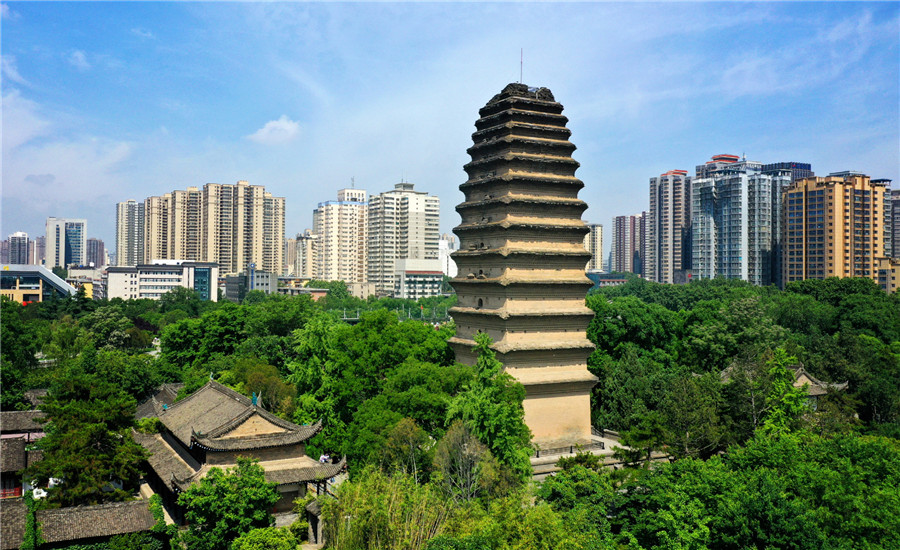
Small Wild Goose Pagoda
Overview
The Small Wild Goose Pagoda is a prominent historical and architectural landmark located in Xi'an, the capital city of Northwest China's Shaanxi province. This ancient structure, with a history spanning over 1,300 years, is one of the two significant Buddhist pagodas erected during the Tang Dynasty (618-907) in Xi'an. It stands as a testament to the rich cultural and religious history of the region and has been recognized as a part of the UNESCO World Cultural Heritage sites. The pagoda is situated within the courtyard of the Xi'an Museum, which itself is located on the site of the historic Jianfu Temple.
Historical Background
The Small Wild Goose Pagoda was built between 707 and 710, during the Jinglong Reign of the Tang Dynasty. It was constructed for the purpose of housing and protecting Buddhist scriptures brought back to China by the dignitary Yijing, a renowned Buddhist traveler and monk. The pagoda's construction was part of a broader effort to establish Jianfu Temple as a key center for Buddhist learning and practice in the region. The temple was initially built in 684 AD to honor Emperor Gaozong of the Tang Dynasty, reflecting the deep connection between the imperial court and Buddhist institutions at the time.
Architectural Features
The Small Wild Goose Pagoda is an exemplary model of early Chinese square dense eaves brick pagoda architecture. Standing at 43.4 meters, this 13-storey structure is characterized by its simple yet elegant design, featuring a square plan and multiple layers of eaves. Unlike the more ornate pagodas that emerged in later dynasties, the Small Wild Goose Pagoda embodies a more austere aesthetic, indicative of the Tang Dynasty's architectural style. Its design reflects the introduction and integration of Buddhism into Han culture, and it served as a blueprint for subsequent pagoda constructions.
Cultural Significance
As a significant cultural relic from the Tang Dynasty, the Small Wild Goose Pagoda represents the historical diffusion of Buddhism into China and its integration within the local culture and traditions. It serves as a cultural landmark that highlights the role of Xi'an as a historical capital where diverse cultural and religious exchanges took place. The pagoda is also part of Xi'an's broader historical landscape, contributing to the city's reputation as a center of ancient Chinese civilization and a hub for the Silk Road.
Preservation and Current Status
The Small Wild Goose Pagoda is currently part of the Xi'an Museum complex, which was inaugurated on May 18, 2007, coinciding with World Museum Day. The museum was constructed on the original site of Jianfu Temple and serves as a custodian of the rich cultural and historical heritage of Xi'an. Recent efforts by the museum have focused on the preservation and digital documentation of ancient books and artifacts related to the pagoda. Furthermore, the museum has engaged in community outreach by developing cultural and creative products that draw inspiration from the pagoda and other historical sites within Xi'an. These initiatives aim to enhance public engagement with the region's historical sites and ensure the continued preservation of its cultural heritage. Article reference1. Xi’an Museum rolls out bookmarks of its typical buildings. chinaservicesinfo.com. 20212. Xi’an Museum. chinaservicesinfo.com. 20183. The Qianxun Pagoda, an example of 9th-century pagodas in China. chinaservicesinfo.com. 20224. Xi'an Museum brings new life to cultural relics. chinaservicesinfo.com. 2022Photo Gallery(1 picture)CategoriesCultural HeritageTagHistorical BuildingWorld Heritage in ChinaRelatedXi’an MuseumCatalogue1. Overview2. Historical Background3. Architectural Features4. Cultural Significance5. Preservation and Current Status- - - []








